I’ve met lots of travellers from Europe and America who’ve told me about Ballina. Usually with eyes sparkling with excitement and a smile on their faces. But what is it that makes this little town so special? We wanted to find out for ourselves…
Intro and travel report
Anyone travelling around Ireland will find wonderful salmon dishes on offer in almost every pub-restaurant. The salmon actually comes from Ireland and always tastes absolutely fantastic!
Atlantic salmon are marvellous fish. They live in both fresh and salt water – something not many fish can do. Adult salmon live in the Atlantic Ocean.
In autumn, however, they swim upstream, from the river mouth to the headwaters. On their journey, they overcome weirs, currents and other obstacles until they reach their destination: their spawning grounds.
They lay their eggs in the gravel of the small rivers and fertilise them. Afterwards, they return to the sea, though many of them never make it back, as the long journey was too exhausting.
In spring, the new generation of salmon hatches and lives in the rivers for about a year until it is strong enough to set off on its journey to the open sea and survive there.
After a few years, they return to the river where they were born to spawn – and the cycle of life continues for another generation…
Ireland’s west coast is washed by the Atlantic Ocean, which, rising from great depths, meets the land here. As a result, Ireland’s bays and rivers are particularly well-suited to hosting salmon on their journey to find spawning grounds.
This takes place every year all along the Irish west coast, but particularly on the north-west coast. The River Moy in County Mayo flows into a large bay on the Atlantic.
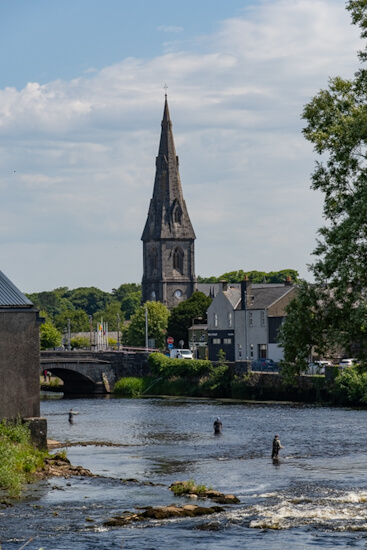
A few kilometres further south, it flows through a small town. There are natural rapids there which the salmon must navigate on their journey upstream, and it is precisely there that you’ll find a small town which is officially Ireland’s ‘salmon capital’ – Ballina.
With just over 10,000 inhabitants, Ballina is the second-largest town in Mayo – yes, the region is very rural. Many centuries ago, there was already a ford across the River Moy here, and a town grew up around it. It was granted town status, was permitted to hold a weekly market, and in the 17th century, significant cotton production and processing followed.
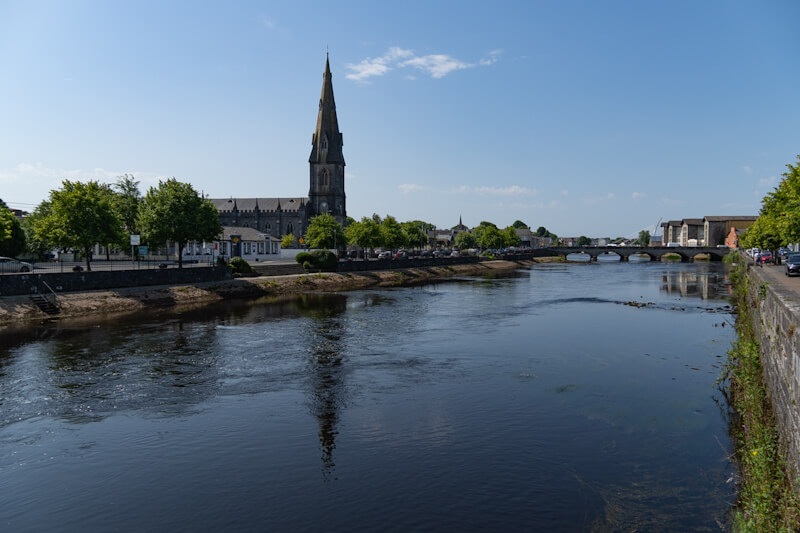
In the 19th century, the beautiful St Muredach’s Cathedral, a Roman Catholic cathedral, was built right on the riverbank.
A short distance away, you’ll find Belleek Forest on the riverbank. At over 300 years old, it is one of the oldest planted forests in Europe. It’s quite astonishing, really, as Ireland doesn’t have very much woodland left these days…
Another place of interest is the Dolmen of the Four Maols on the outskirts of town. It is a structure dating back several thousand years.
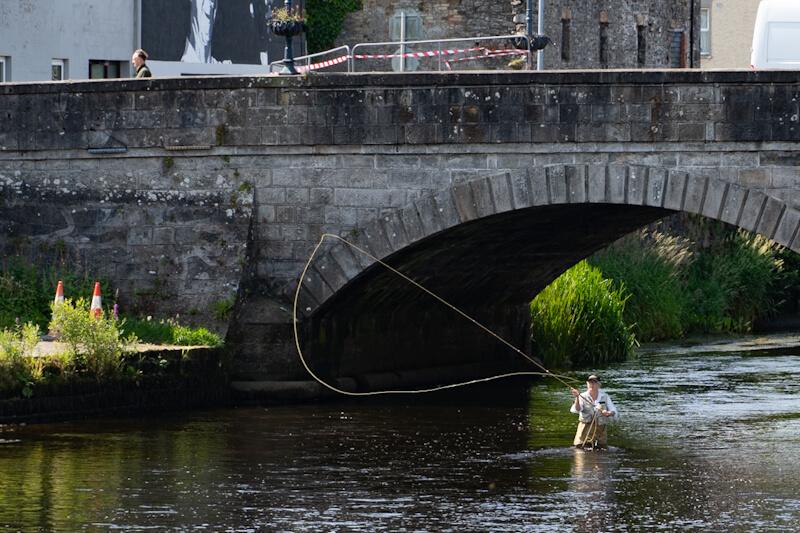
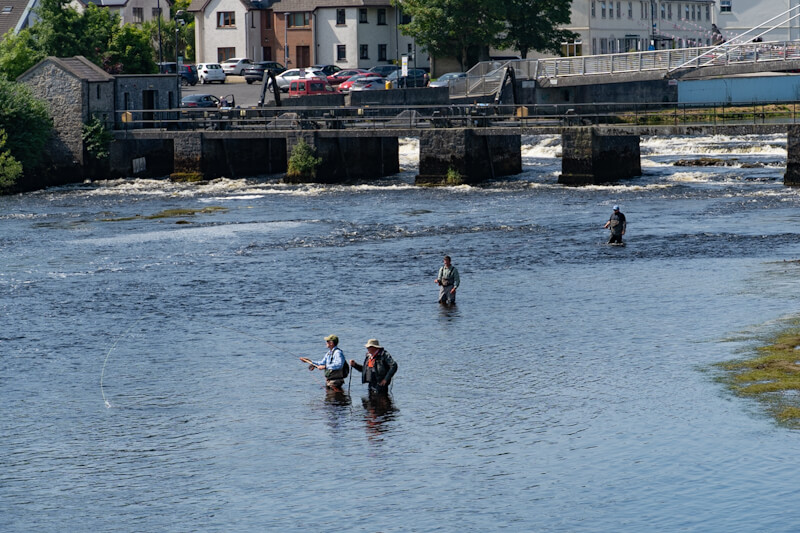
None of this matters much to the salmon, which have also been swimming up and down the river for thousands of years (or longer). What is more of a nuisance on their journey are the many anglers standing in the river in long waders, casting their hooks with skilful throws.
Fly fishing is the only proper (and permitted) way to fish for salmon. It is late summer, early autumn, when we stop off in Ballina with our motorhome.
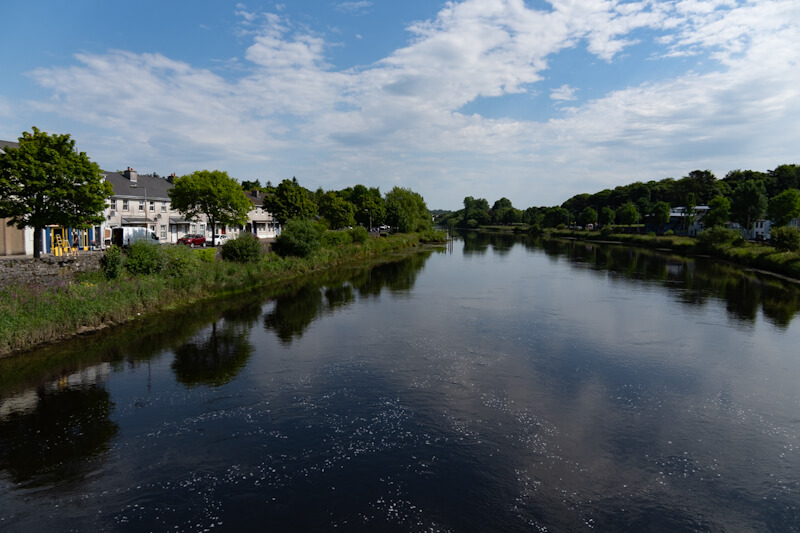
The sun shines warmly on the town, which stretches along both banks of the river. A surprisingly heavy flow of traffic struggles along the banks and across the bridge – not at all to my taste.
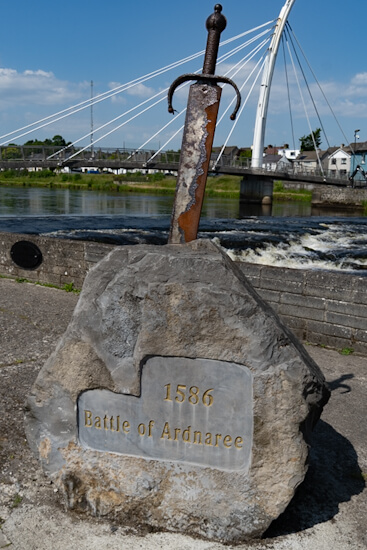
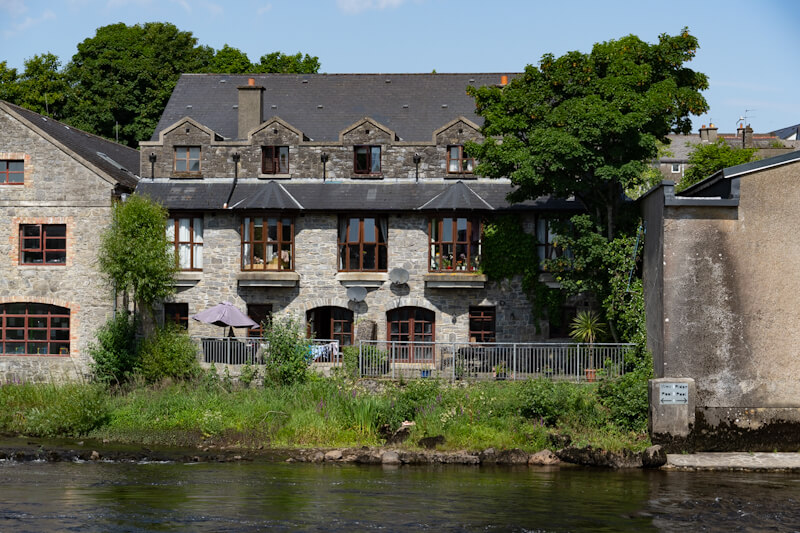
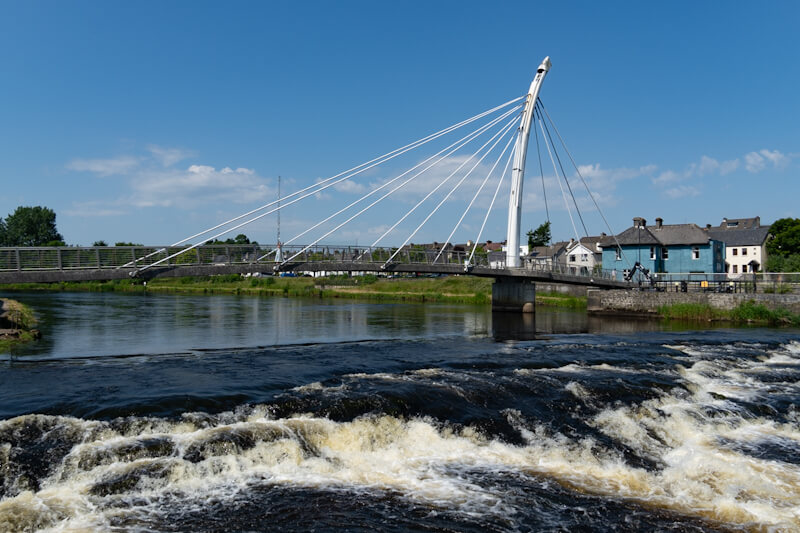
There are quite a few anglers by the river, and a fishing shop is situated right on the bank. Just a little further on, it becomes quieter: at Salmon Weir, a footbridge spans the river. Small, colourful houses dominate the scene. A few restaurants can be seen on the riverbank, along with a hotel.
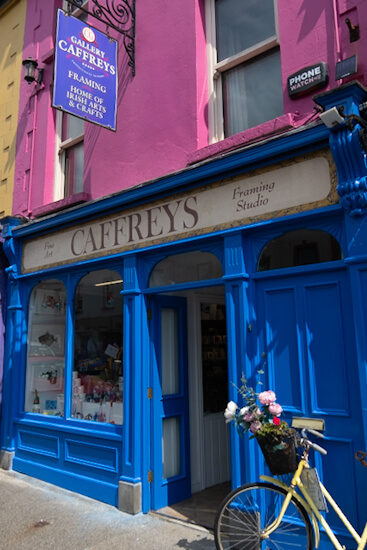
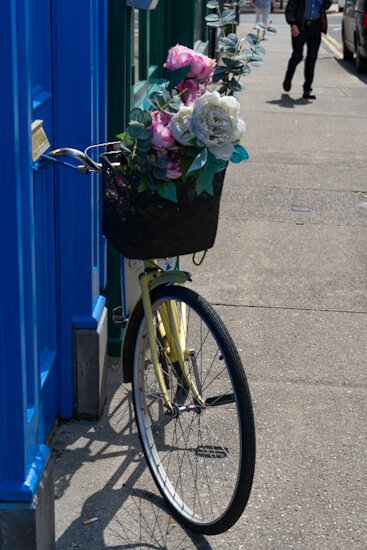
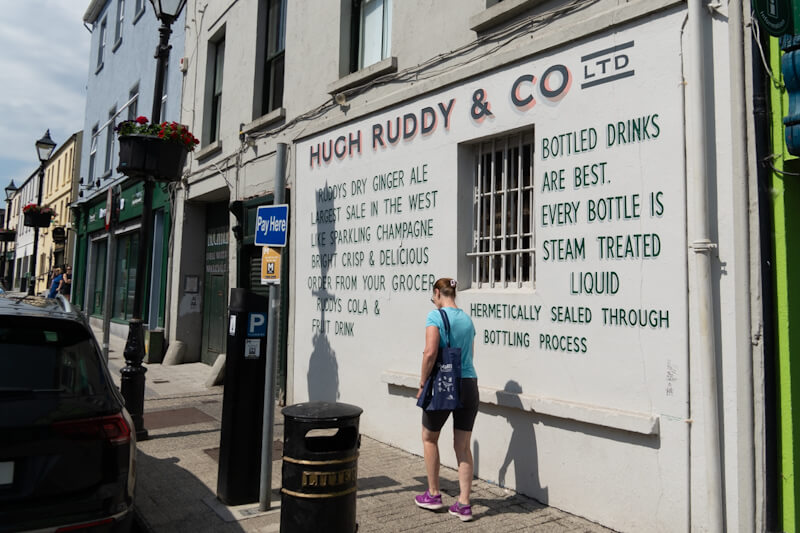
On the other side, I follow narrow streets into the town centre. There are cars here too, but it’s much quieter than on the main road. There are lots of small shops, an ice-cream parlour, pubs and restaurants. It’s a bustling scene in a typical, old Irish market town with plenty of charming spots.
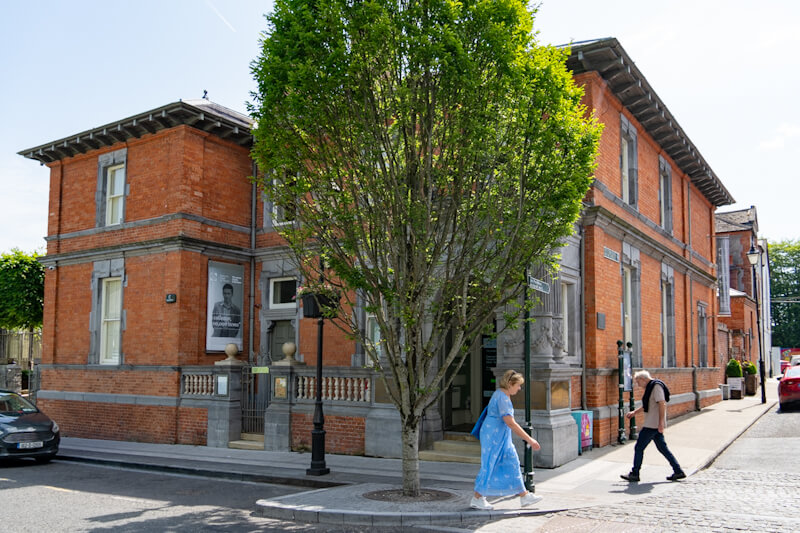
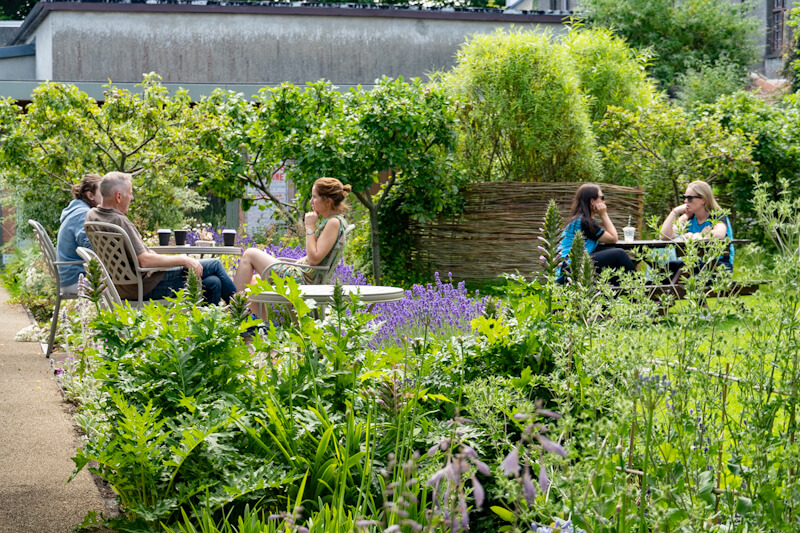
There’s a particularly charming spot on Pearse Street with its pretty houses. This is also where you’ll find the Jackie Clarke Collection, a beautiful house with a wonderful park and an art collection inside. The park is open to the public and there are tables and a café there too. See: https://www.clarkecollection.ie.
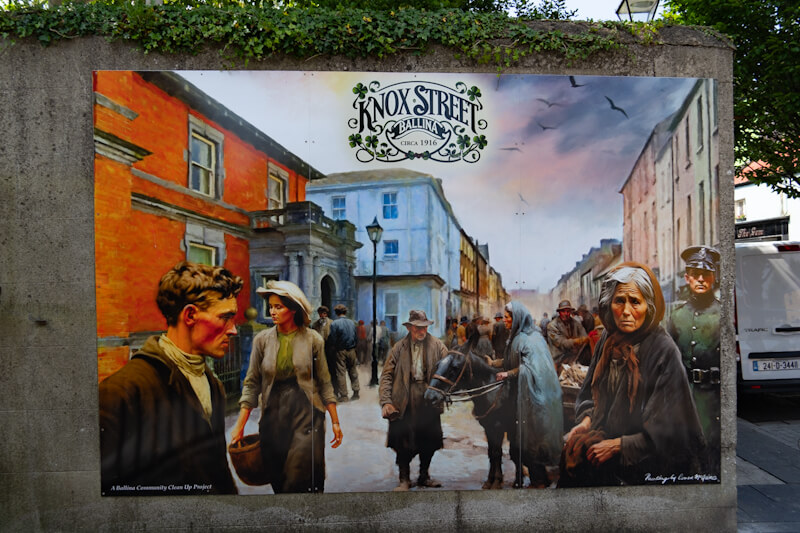
The walls surrounding the Jackie Clarke estate are artistically painted both inside and out: there are lots of motifs from Irish history, and it looks absolutely brilliant.
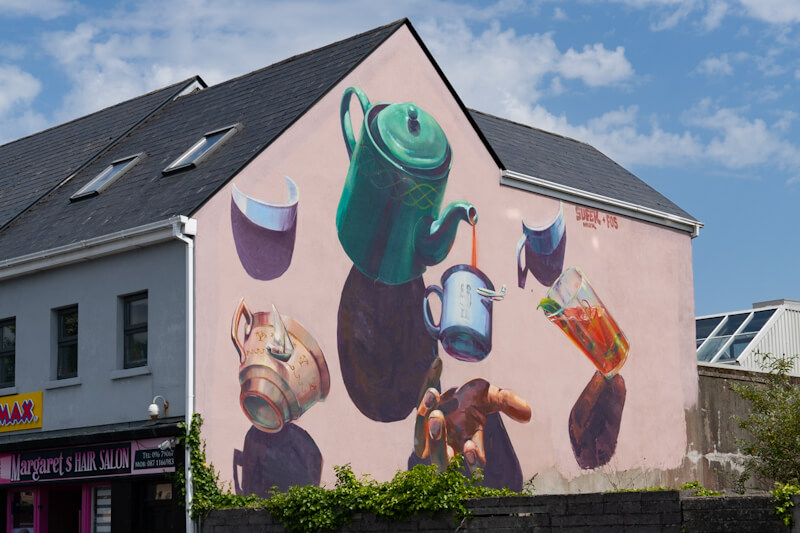
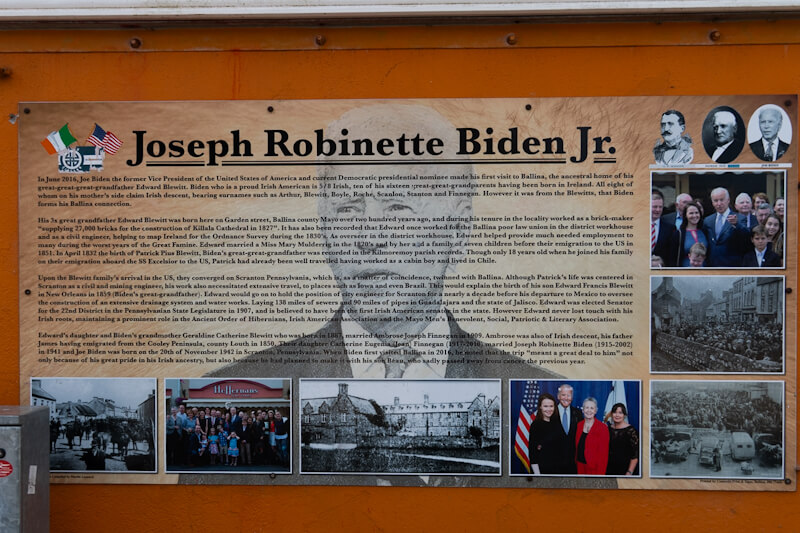
Further along Pearse Street, there are more fantastic murals on the walls. The old Market Square is also well worth a visit. Here, too, there are murals and an information board about Joe Biden. The former US President’s ancestors were from Ballina.
I find the idea appealing enough to have lunch nearby, and then I take a leisurely stroll back to the river. I look at the cathedral on the other side of the river and gaze at the water as it flows steadily past the town.
A constant flow of water, a constant flow of salmon, a constant flow of history, the present and the future. Yes, everything feels just right in Ballina!
My wife has finished her shopping too, and we set off again, feeling content – just like the salmon…
Many people I know have used Ballina as the starting or finishing point for a trip along the wild Atlantic coast. To me, that has always seemed illogical, as further north there are Sligo and Donegal, which are also well worth a visit.
But if you only have a week, you can also start in the south-west and finish in Ballina – or vice versa.
Conclusion
Many people I know have used Ballina as the starting or finishing point for a trip along the wild Atlantic coast. To me, that has always seemed illogical, as further north there are Sligo and Donegal, which are also well worth a visit.
But if you only have a week, you can also start in the south-west and finish in Ballina – or vice versa.
Is Ballina a must-see? Not necessarily. But it’s worth a visit. The little town is lovely, its riverside setting is particularly beautiful, and its geographical location is appealing:
To the south-west lies the beautiful Achill Island (accessible via a bridge); to the north-west are the Ceide Fields, an ancient and fascinating archaeological site situated right next to high cliffs; and very close by is the spectacular Downpatrick Head with its striking rock pinnacle jutting out into the sea.
Ballycroy National Park in the west is ideal for walking, and the whole north-western coast is simply beautiful and not at all crowded. Ballina is therefore a great place to stay for several nights and serves as a good base for a number of day trips.
More interesting articles for you
DONEGAL TOWN: THE NORTH-WEST IS COOL!
GLENVEAGH CASTLE: A DREAM IN THE MIDDLE OF NOWHERE…
SLIGO: STAY OR MOVE ON..?
Credit for cover photo: At the Salmon Weir in Ballina (Photo: Ulrich Knüppel-Gertberg)
